Tesla (maker of electric cars) wants to help Puerto Rico rebuild their power grid. The hurricane destroyed most of the power grid, and in some areas, 100% of people were out of power for 2 or more weeks.
Tesla wants to help build a new solar power grid by storing power in giant battery banks, and distributing that power over power lines. This would be a networked design so there would be solar collectors and battery banks in several different cities. The PR power company was on the verge of bankruptcy when the hurricane hit so the power infrastructure was already poor, damaged, and need of repair at best.
Tesla has already sent hundreds of Powerwalls to help people, but those need electricity to recharge.
Sources
Youtube video.
Showing posts with label energy. Show all posts
Showing posts with label energy. Show all posts
Monday, November 13, 2017


Friday, November 10, 2017
RMS wants to get into the battery business
Robert Murray-Smith created his own company, FWG, with 2 partners. He is working on making a better battery. He already has a test format for powering an electric bike. Initial tests are promising. His videos are very open and he gives you recipes and instructions for making your own graphite capacitors and other energy-related items.
Sources
The FWG website.
RMS Youtube channel.
Article: http://revolution-green.com/fwg-battery-sale-robert-murray-smith/
Sources
The FWG website.
RMS Youtube channel.
Article: http://revolution-green.com/fwg-battery-sale-robert-murray-smith/
Sunday, October 1, 2017
How to power things using batteries and alt power, part 2 of 2
Part 2 of 2
Power draw from the battery
If all 4 amps is being used on the Amazon inverter, how many amp hours are actually being drawn from your battery? 4 amps / 0.8 (efficiency rate), or about 5 amps per hour. Worst case scenario for an inverter that provides 4 amps: If your battery holds 20 amp hours, it will last for 20 amp hours / 5 amps per hour, or 4 hours if there is no power being added to the battery. If your battery holds 80 amp hours, it will last for 80 / 5 amps per hour, or 16 hours of continuous use with no power being added to the battery.
Examples of batteries
Below is a variety of batteries. I don't know about their quality, but let's compare the cost per amp hour of capacity. Do not use "cold cranking amps" for capacity, find the amp hours rating.
- Optima Marine battery, $200 for 55 amp hours. Cost per amp hour: $3.64usd
- 12v battery, $100 for 35 amp hours: $2.86usd
Power draw from the battery
If all 4 amps is being used on the Amazon inverter, how many amp hours are actually being drawn from your battery? 4 amps / 0.8 (efficiency rate), or about 5 amps per hour. Worst case scenario for an inverter that provides 4 amps: If your battery holds 20 amp hours, it will last for 20 amp hours / 5 amps per hour, or 4 hours if there is no power being added to the battery. If your battery holds 80 amp hours, it will last for 80 / 5 amps per hour, or 16 hours of continuous use with no power being added to the battery.
Examples of batteries
Below is a variety of batteries. I don't know about their quality, but let's compare the cost per amp hour of capacity. Do not use "cold cranking amps" for capacity, find the amp hours rating.
- Optima Marine battery, $200 for 55 amp hours. Cost per amp hour: $3.64usd
- 12v battery, $100 for 35 amp hours: $2.86usd
Saturday, September 30, 2017
How to power things using batteries and alt power, part 1 of 2
I've been looking into using solar power and batteries to power things. My first kit is used to charge a battery using a small panel, about 12" x 8", and the battery powers an LED light. The battery box also has a 5vdc USB port for charging USB things. Or simply for powering a USB device like a USB fan.
Terms
Here are some terms to get you started.
My next step was looking into using a solar and battery system to power my flat screen TV.
Alternative power usually uses an energy producing device to charge up a battery. If you use solar power (photovoltaics) you are using a solar panel to charge up a battery, and the battery stores energy for later use. You won't need lights during the daytime when the sun is out, so the battery provides power for nighttime use.
In the case of wind power or hydro power, in both cases they turn a generator to produce power, which then charges a battery for energy storage.
But how do you size the system to meet your needs? A battery provides DC power but your TV needs AC power. So you will need an inverter to change from DC to AC power. Buying an inverter based on watts it supports is not helpful. You need to look at relevant energy units, volts and amps. While watts = volts * amps, watts is just a very general way of looking at things. The inverter must provide both the volts and amps our TV needs.
My TV is rated at 12vac and 50 watts (labeled "50w" on the back of the TV). This does not tell us the amps that it draws/uses so we must calculate that. 50/120vac = 0.417 amps, or 417 milliamps (called "mA" with a big A). Amps is how much power it uses per hour. "Amp hours" is for battery capacity, and is how many hours a battery will provide 1 amp. A 1 amp hour (Ah) battery provides 1 amp for 1 hour before the voltage gets too low to be useful.
Terms
Here are some terms to get you started.
- Amps: how much current a device draws, per hour. A 1 amp device uses 1 amp per hour.
- Amp hours: the capacity of a battery. A 2 amp hour (Ah) battery provides 2 amps for 1 hour, or 1 amp for 2 hours, or 0.5 amps for 4 hours.
- Volts: volts is another measurement of a battery. Devices have a minimum voltage they need to run. A radio powered by 2 AA batteries needs about 3.0 volts to run (2 * 1.5 for each AA). An LED can work on a range of voltages. If the ideal voltage for maximum brightness of an LED is 3.3vdc, then as the battery is used up, the voltage drops, and the LED gets dimmer. The LED might go out at about 2.9vdc.
- Watts: A general unit of measure which is volts * amps used. A 12vdc device that uses 0.5 amps per hour uses 12 * 0.5, or 6 watts per hour. Electricity in the US is charged by 1000 watts per hour, or 1 kw per hour.
My next step was looking into using a solar and battery system to power my flat screen TV.
Alternative power usually uses an energy producing device to charge up a battery. If you use solar power (photovoltaics) you are using a solar panel to charge up a battery, and the battery stores energy for later use. You won't need lights during the daytime when the sun is out, so the battery provides power for nighttime use.
In the case of wind power or hydro power, in both cases they turn a generator to produce power, which then charges a battery for energy storage.
But how do you size the system to meet your needs? A battery provides DC power but your TV needs AC power. So you will need an inverter to change from DC to AC power. Buying an inverter based on watts it supports is not helpful. You need to look at relevant energy units, volts and amps. While watts = volts * amps, watts is just a very general way of looking at things. The inverter must provide both the volts and amps our TV needs.
My TV is rated at 12vac and 50 watts (labeled "50w" on the back of the TV). This does not tell us the amps that it draws/uses so we must calculate that. 50/120vac = 0.417 amps, or 417 milliamps (called "mA" with a big A). Amps is how much power it uses per hour. "Amp hours" is for battery capacity, and is how many hours a battery will provide 1 amp. A 1 amp hour (Ah) battery provides 1 amp for 1 hour before the voltage gets too low to be useful.
Thursday, September 7, 2017
Europe renewable energy consumption is up to 76% in some places
Renewable energy consumption as percent of total energy consumption is 76% in some places. Iceland uses 76% of energy from renewables but that is probably mostly geothermal. But other numbers range from 11 to 50%.

Source
Alternet.

Source
Alternet.
Wednesday, August 23, 2017
Micro hydro power can charge your power bank while you shower
There are a couple micro-hydro power generators on Ebay. These are not full kits, you will need to hook up a USB charger board to it to limit the output to 5vdc, and you will have to add a female USB port. This one hooks to any standard US pipe water supply, like your shower, and is said to generate 5-12v of power. But tests show it only generates 5v with no load, and 4.2vdc with a load. 4.2vdc is not enough to charge your power bank, but if you add a power booster to boost it to 5vdc it should work. This means it will generate power while you shower, wash your hands, or while the toilet tank is filling with water. You get more use out of the flowing water.
This is the same style as above and is stated to generate 100ma, at no load, which sounds more accurate.
This one has no case and is an open turbine. Again, it is unlikely to meet it's stated specs with a load on it. The threads might be for standard US water supplies, but I can't be sure. Also note that a US garden hose thread is not the same as a US water supply pipe thread. But there are adapters to go from one to the other. Some specs for this item:
This one with a case, claims to output 8.8vdc to 15vdc. At $8.10usd out the door, higher than the first item mentioned above, let's hope it outputs 5vdc even with a load.
This is the same style as above and is stated to generate 100ma, at no load, which sounds more accurate.
This one has no case and is an open turbine. Again, it is unlikely to meet it's stated specs with a load on it. The threads might be for standard US water supplies, but I can't be sure. Also note that a US garden hose thread is not the same as a US water supply pipe thread. But there are adapters to go from one to the other. Some specs for this item:
This one with a case, claims to output 8.8vdc to 15vdc. At $8.10usd out the door, higher than the first item mentioned above, let's hope it outputs 5vdc even with a load.
- Water inlet/outlet: 1/2"
- Output Voltage: DC9.8~18.5V/no-load,
- DC8.8 ~ 15V/0.1K load Max power : 3.5W
- Output Current: 128 to 260 MA/0.1 K load
- Water Pressure: 0.08 ~ 0.45MP
- Maximum Water Pressure: 0.55MP
Tuesday, August 22, 2017
Printable solar panels
There has been news about printable solar cells going back to 2008-2012, and it's worth looking into. There should have been consumer products on the market by now (2017) since these cells are cheaper to print (though the article I saw didn't say if they are cheaper per square inch or cheaper per watt of power generated).But I haven't been able to confirm that the flexible solar cells are indeed printed.
So here is a smattering of articles to get you going.
2008: This article mentions Konarka company making printed solar cells. http://inhabitat.com/printable-solar-cells-demonstrated/
2011: News from MIT. http://news.mit.edu/2011/printable-solar-cells-0711
2017: An article from Science Daily, Feb 2017. https://www.sciencedaily.com/releases/2017/02/170216142800.htm
June 2017. University of Newcastle in Australia print solar cells. These cells are translucent and let some sunlight in while at the same time generate power. These are great for putting in south-facing windows in the northern hemisphere. http://planetark.org/news/display/1281
If you have a link to print your own solar cells at home, please leave a comment with the link to share with others. Thanks!
EDIT: While not exactly printed, Power Film Solar has flexible solar panels.
Links
Printable Solar Cells. Book on printing solar cells.
So here is a smattering of articles to get you going.
2008: This article mentions Konarka company making printed solar cells. http://inhabitat.com/printable-solar-cells-demonstrated/
2011: News from MIT. http://news.mit.edu/2011/printable-solar-cells-0711
2017: An article from Science Daily, Feb 2017. https://www.sciencedaily.com/releases/2017/02/170216142800.htm
A new innovation could make printing solar cells as easy and inexpensive as printing a newspaper. Researchers have cleared a critical manufacturing hurdle in the development of a relatively new class of solar devices called perovskite solar cells. This alternative solar technology could lead to low-cost, printable solar panels capable of turning nearly any surface into a power generator.Wikipedia: Inkjet solar cells. Retrieved Aug 21, 2017.
June 2017. University of Newcastle in Australia print solar cells. These cells are translucent and let some sunlight in while at the same time generate power. These are great for putting in south-facing windows in the northern hemisphere. http://planetark.org/news/display/1281
If you have a link to print your own solar cells at home, please leave a comment with the link to share with others. Thanks!
EDIT: While not exactly printed, Power Film Solar has flexible solar panels.
Links
Printable Solar Cells. Book on printing solar cells.
Saturday, August 19, 2017
Low-powered LED light in the works
From Newsatlas: A new flat-panel LED light could reduce power use tremendously. Scientists at Tohoku University in Japan have made a cheaper LED lighting device in the form of a flat panel that gets efficiency of 60 lumens per watt, which is pretty darn good for their simple device that has not been tweaked. It uses nanotubes to get this kind of efficiency.

Each carbon nanotube acts similar to a cathode ray tube when a strong electric field is applied. The electric field requires 5kv to work but the device itself uses very little power.
People have been working on other ways for LEDs to use less power. Some pulse power so fast the human eye cannot detect the LED going off and on. One project is the TritiLED which aims to light a dim LED to be used as a marker, for about 10 years. There is also the Decade Flashlight.
Update Nov 2018: My Tritiled, acquired in July 2016, has been running for 2 years straight with no problem. It's never been turned off.
Source
Newatlas.
Review of Scientific Instruments.
DDG search for articles.
Each carbon nanotube acts similar to a cathode ray tube when a strong electric field is applied. The electric field requires 5kv to work but the device itself uses very little power.
People have been working on other ways for LEDs to use less power. Some pulse power so fast the human eye cannot detect the LED going off and on. One project is the TritiLED which aims to light a dim LED to be used as a marker, for about 10 years. There is also the Decade Flashlight.
Update Nov 2018: My Tritiled, acquired in July 2016, has been running for 2 years straight with no problem. It's never been turned off.
Source
Newatlas.
Review of Scientific Instruments.
DDG search for articles.
Tuesday, August 15, 2017
Super efficient nano-LED research
This is not the same as a super efficient LED circuit where a battery could light an LED for 10 years. This is a whole new LED technology at the nanoscale.
One of the larger bottlenecks between microchips is the data connections. An optical connection, rather than a wire connection, would speed things up, but a light source small enough was not available until now. Scientists at TU Eindhoven made a nano LED that is 1000 times more efficient and can communicate at gigabits per second.
But since this article is from 2017, expect to wait another 8-10 years before we see these things in consumer devices... if it can be made at a reasonable price that is.
Source
Elektor Magazine. 3/6/2017.
One of the larger bottlenecks between microchips is the data connections. An optical connection, rather than a wire connection, would speed things up, but a light source small enough was not available until now. Scientists at TU Eindhoven made a nano LED that is 1000 times more efficient and can communicate at gigabits per second.
But since this article is from 2017, expect to wait another 8-10 years before we see these things in consumer devices... if it can be made at a reasonable price that is.
Source
Elektor Magazine. 3/6/2017.
Saturday, July 8, 2017
LED light that creates more energy than it uses?
(This is from 2012 but it's still interesting to see if this technology became a product.)
With incandescent bulbs, only 10% of the energy used is converted the light, the rest is converted to heat. Current LED diodes, (as opposed to "LED bulbs" which can contain many diodes) use only about 17% of the energy of an incandescent bulb and do not create much heat, which is good for heat-sensitive applications. For example, when I used standard (incandescent) bulbs in my outside yard light, and winters got to -20F ambient temperatures, the heat from the bulb would eventually crack and destroy the bulb itself from the sheer difference in temperature and the speed at which the bulb heated up. This was long ago and we moved to fluorescent bulbs at the time.
What if there was an LED bulb that produced more energy than it used? MIT researchers claim they have a bulb that creates energy as it uses it. It is 230% efficient, and seems to defy the laws of physics. But how to harvest that energy?
They researchers had a theory of using less voltage.
(I seriously doubt the LED produced light visible to humans but perhaps this concept can be multiplied by using 100s of LED emitters.)
Sources
Inhabitat, 3/24/2012. Retrieved 7/6/2017.
Gizmodo article. Retrieved 7/6/2017.
The journal article. Feb 27, 2012. APS.org. Retrieved: 7/6/2017.
With incandescent bulbs, only 10% of the energy used is converted the light, the rest is converted to heat. Current LED diodes, (as opposed to "LED bulbs" which can contain many diodes) use only about 17% of the energy of an incandescent bulb and do not create much heat, which is good for heat-sensitive applications. For example, when I used standard (incandescent) bulbs in my outside yard light, and winters got to -20F ambient temperatures, the heat from the bulb would eventually crack and destroy the bulb itself from the sheer difference in temperature and the speed at which the bulb heated up. This was long ago and we moved to fluorescent bulbs at the time.
What if there was an LED bulb that produced more energy than it used? MIT researchers claim they have a bulb that creates energy as it uses it. It is 230% efficient, and seems to defy the laws of physics. But how to harvest that energy?
They researchers had a theory of using less voltage.
As you may have guessed, significantly lowering the input power creates a very weak LED bulb. In their tests, the MIT researchers succeeded in generating about 70 picowatts of light from 30 picowatts of energy — an efficiency of 230 percent!Artugo Verdugo comments on the Inhabitat story:
From what I know, this LEDs are more than 100% efficient because they are using electricity+environmental heat to produce light. That means that a large portion of the power being used comes directly from the environment.At this point, neither 30 nor 70 picowatts will light any LED, but it's an interesting observation.
(I seriously doubt the LED produced light visible to humans but perhaps this concept can be multiplied by using 100s of LED emitters.)
Sources
Inhabitat, 3/24/2012. Retrieved 7/6/2017.
Gizmodo article. Retrieved 7/6/2017.
The journal article. Feb 27, 2012. APS.org. Retrieved: 7/6/2017.
Thursday, July 6, 2017
Can LED lights run for 25 years? 10 years?
Some people are working on circuits to make a dim LED light run for a year, or even 25 years. The initial attempts are to provide "marker lights". These lights are not light enough to use to walk around in the dark or read by, but they are perfect for marking tent pegs, camp sites, or trails at, for example, concerts or camp sites. They can also be used to mark latrines which are often some distance from camp sites, and be used in astronomy to possibly read text (although the lights are not very bright).
Tritium gas tubes last about 10 years, but they are expensive and not available legally in the US for hobbyists. Also there are some fakes sold on Ebay that only last a few months. In the US they can only be sold as part of a watch, gun sight or compass. Ebay does not appear to regulate plain tritium vials sold to the US.
Tritium gas tubes last about 10 years, but they are expensive and not available legally in the US for hobbyists. Also there are some fakes sold on Ebay that only last a few months. In the US they can only be sold as part of a watch, gun sight or compass. Ebay does not appear to regulate plain tritium vials sold to the US.
Tuesday, May 16, 2017
Beginner solar starter kit for $70!
Here it is: One solar panel, charge controller with 4000mah lithium battery, 2 LED light bulbs, for $70usd. I have this one and it works great.
Here's one for $61usd: two lightbulbs, 8000mah hour battery, charge controller, solar panels.
These can be good for sheds or workshops too!
Notes about solar power.
- The solar panel has brackets to mount the panel on the roof at the correct angle, and has long wires from the solar panel so you can link to the battery indoors.
- Also has 1 USB charging port, with USB cable with many adapters.
- Charging box (contains battery) also has on/off switch which turns off all lights to make sure no energy is used during vacation. Each light bulb has a tiny red LED to show you there is power going to it.
- I will splice in a voltmeter to monitor the voltage myself later.
Here's one for $61usd: two lightbulbs, 8000mah hour battery, charge controller, solar panels.
These can be good for sheds or workshops too!
Notes about solar power.
- The systems above are too small to run a TV but work fine for LED lights, which are typically low powered. Since some of the systems have a USB port, those will run any USB device like a small light, fan, or charge power banks, etc.
- Charging of the battery can take a long time in overcast or dark weather. Batteries charge best in full sun where the suns rays hit the solar panel at 90 degrees.
- Solar panels should be placed in south-facing windows or on the roof facing south.
- Latitudes of the earth go from zero (equator) to 90 degrees (north or south pole). The best angle for the solar panel is (if you live in the Northern hemisphere): the angle formed between the ground and the panel should equal your latitude. I.e. at 30 degrees, closer to the equator, the angle would be 30 degrees from the ground, or close to horizontal. For latitude 85, the panel should be 85 degrees from the ground, or nearly vertical. At 43 degrees latitude put the panel at 43 degrees to the ground. This will help your panel get the most sunlight as the sun moves throughout the day.
Saturday, May 13, 2017
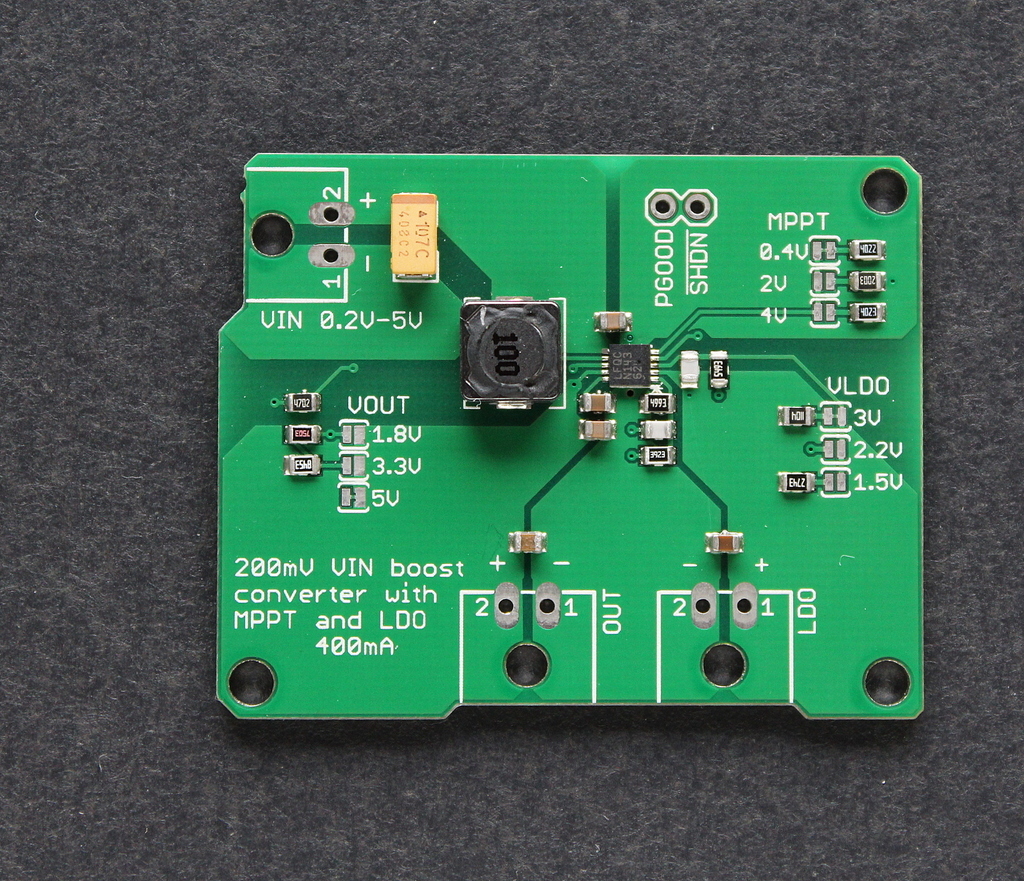
Voltage booster goes from 225mv to 5.0vdc!
This [voltage booster](http://www.ebay.com/itm/LTC3105-Energy-Harvester-demo-module/332136264440?_trksid=p2047675.c100005.m1851&_trkparms=aid%3D222007%26algo%3DSIC.MBE%26ao%3D2%26asc%3D40130%26meid%3De7f86a5b8374439ab3c85d2657cfcb85%26pid%3D100005%26rk%3D3%26rkt%3D6%26sd%3D332071662285) on Ebay takes input as low as 225mv and boosts it to 3.3v or 5vdc.
This can be really useful for boosting power from solar panels on a cloudy day, thermoelectric generation, using the last bit of juice from batteries, and more! WARNING: do not over discharge lithium batteries! They can be permanently damaged. A booster like this would be for like AA alkaline batteries.
The seller, ceech123, has several other similar boards, one even for 2.7v supercaps.

This can be really useful for boosting power from solar panels on a cloudy day, thermoelectric generation, using the last bit of juice from batteries, and more! WARNING: do not over discharge lithium batteries! They can be permanently damaged. A booster like this would be for like AA alkaline batteries.
The seller, ceech123, has several other similar boards, one even for 2.7v supercaps.
Monday, May 1, 2017
Solid electrolytes can lead the way to safer batteries!
Researchers at a Japanese institute (KEK, no that's not a Reddit joke, that's the letters of the institute) have come up with a substance to act as a solid electrolyte in lithium batteries. But researchers at Tufts University are doing something similar. A solid electrolyte greatly reduces the chance of a "runaway reaction", or spontaneously exploding batteries like Samsung had. But many problems have to be overcome with a battery technology:
Source
Phys.org. 2016-03.
- Self-discharge is bad. It should be low or zero.
- Should not explode.
- Should work from -30C to 100C.
- If they are rechargeable they should have fairly good recharge time, and the power they can save should not degrade as fast as current technology.
- They should be cheap enough for consumers.
- Ability to scale up production for consumer use.
Source
Phys.org. 2016-03.
Monday, April 24, 2017
Holey graphene might make better batteries
At Northwestern University, engineers have made a new type of graphene* electrode: one punched with many microscopic holes. It could store 10x as much power (30,000mah instead of 3000) and charge 10x faster. As with any new technology, a big problem is to make it cheap enough for consumers to buy.
* Graphene is a single layer of carbon atoms, usually on a substrate. "Graphite" is actually many layers of graphene.
Source
Stanford Extreme Tech. 2011.
* Graphene is a single layer of carbon atoms, usually on a substrate. "Graphite" is actually many layers of graphene.
Source
Stanford Extreme Tech. 2011.
Monday, April 10, 2017
Joule Thief circuits
A Joule Thief is a circuit that can boost voltage. It can be useful to make LED flashlights, or for emergencies, where you only have a single 1.5vdc battery. The Joule Thief (JT) can be used to boost the 1.5vdc to 3.0vdc or more. All the parts can be bought at Radio Shack, or Ebay.
The below Joule Thief is very efficient. It can be made from simple parts and is powered by one AA battery (or any 1.5v battery).
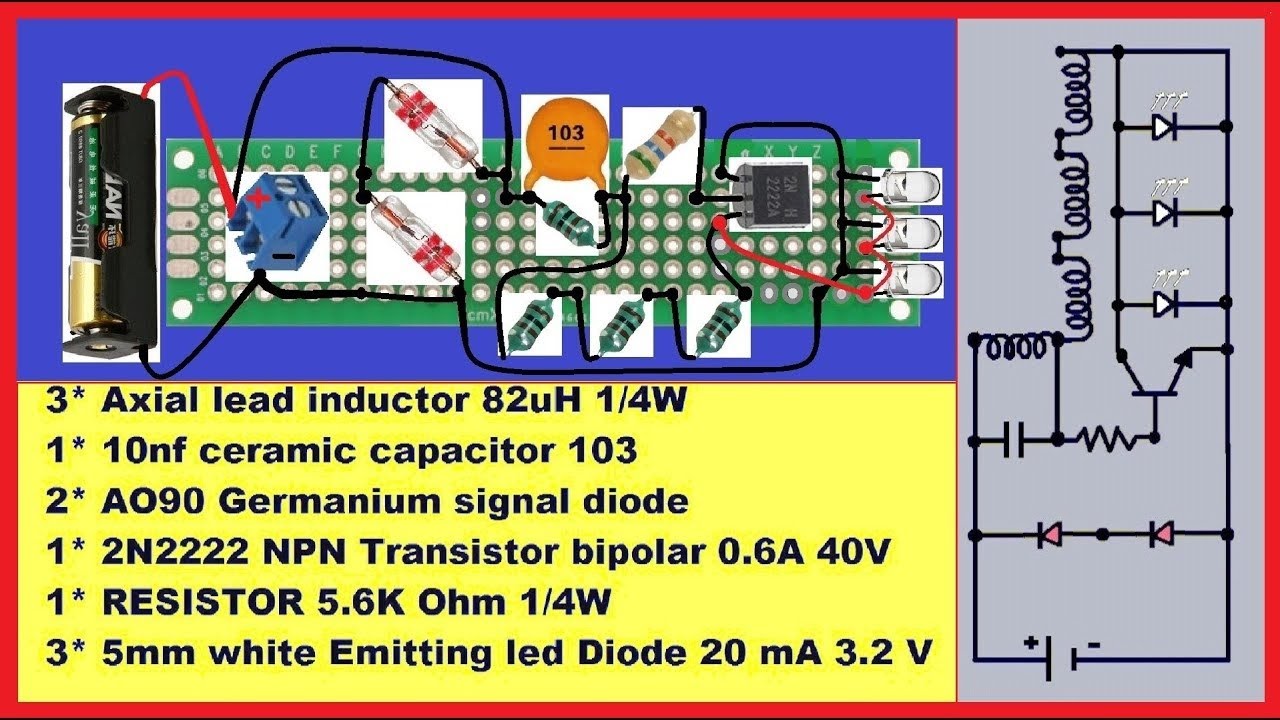 This Joule Thief needs 0.4v-1.5vdc as input. You will have to make your own custom toroid though.
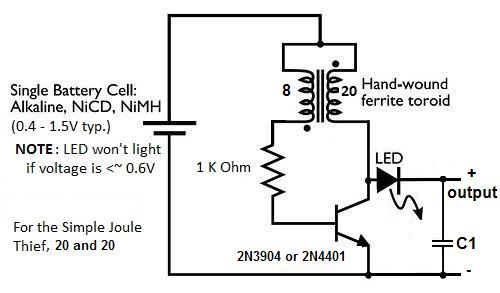
 Below is another simple JT circuit.

The below Joule Thief is very efficient. It can be made from simple parts and is powered by one AA battery (or any 1.5v battery).
Monday, April 3, 2017
Broken energy meters report up to 600% more energy used than actually used
A new study by the University of Twente in Holland shows many meters can give inaccurate readings, in some cases showing up to 582% more energy used than was actually used. The most problematic meters are the newer digital "smart" meters. Older meters with a rotating disk are more accurate.
Monday, March 6, 2017
Self-charging battery from Phys.org
Usually 2 separate units are used to generate and store energy. 1. Something to generate the energy, like solar, coal, gas, etc. 2. A battery to store the energy. Now for the first time, using nanomaterials, a self-charging battery has been made.
They used a PVDF film, which is a piezoelectric material. That means when it's compressed, it generates a small amount of electricity. This is how many cigarette and barbecue lighters work. You have to press that "ignite" button pretty hard to make a spring-loaded hammer smack a piezoelectric material, to generate that spark.
A compressive force at 2.3Hz could generate 327 to 395 millivolts. While that is not enough to power an LED, which requires about 2200mv, that voltage can be boosted somewhat. This important because it creates energy from mechanical movement in one step.
Phys.org. 2012-08.
Study: Xinyu Xue, et al. “Hybridizing Energy Conversion and Storage in a Mechanical-to-Electrochemical Process for Self-Charging Power Cell.” Nano Letters. DOI: 10.1021/nl302879t.
They used a PVDF film, which is a piezoelectric material. That means when it's compressed, it generates a small amount of electricity. This is how many cigarette and barbecue lighters work. You have to press that "ignite" button pretty hard to make a spring-loaded hammer smack a piezoelectric material, to generate that spark.
A compressive force at 2.3Hz could generate 327 to 395 millivolts. While that is not enough to power an LED, which requires about 2200mv, that voltage can be boosted somewhat. This important because it creates energy from mechanical movement in one step.
A compressive force with a frequency of 2.3 Hz could increase the voltage of the device from 327 to 395 mV in 4 minutes.
Read more at: https://phys.org/news/2012-08-self-charging-battery-energy.html#jCp
Read more at: https://phys.org/news/2012-08-self-charging-battery-energy.html#jCp
A compressive force with a frequency of 2.3 Hz could increase the voltage of the device from 327 to 395 mV in 4 minutes.
Read more at: https://phys.org/news/2012-08-self-charging-battery-energy.html#jCp
Read more at: https://phys.org/news/2012-08-self-charging-battery-energy.html#jCp
A compressive force with a frequency of 2.3 Hz could increase the voltage of the device from 327 to 395 mV in 4 minutes.
Read more at: https://phys.org/news/2012-08-self-charging-battery-energy.html#jCp
SourceRead more at: https://phys.org/news/2012-08-self-charging-battery-energy.html#jCp
Phys.org. 2012-08.
Study: Xinyu Xue, et al. “Hybridizing Energy Conversion and Storage in a Mechanical-to-Electrochemical Process for Self-Charging Power Cell.” Nano Letters. DOI: 10.1021/nl302879t.
Xinyu Xue, et al.
“Hybridizing Energy Conversion and Storage in a
Mechanical-to-Electrochemical Process for Self-Charging Power Cell.” Nano Letters. DOI: 10.1021/nl302879t
Read more at: https://phys.org/news/2012-08-self-charging-battery-energy.html#jCp
Read more at: https://phys.org/news/2012-08-self-charging-battery-energy.html#jCp
Sunday, March 5, 2017
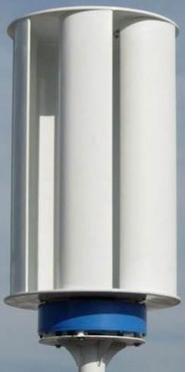
Interesting Vertical Wind turbine
Near VAWT. I wonder if they just sell the turbine?
A 3-d printed VAWT that uses old plastic shades for some parts.
A box fan wind turbine. NOTE: box fan motors are not normally DC motors. You will probably have to swap out the old motor for a DC motor.
 A PC fan wind turbine. These are often DC motors but not always. Check the motor carefully. You need a DC motor for generating electricity easily.
 And another one that looks easy to make out of PVC tubing glued to plastic sheets.
 Here's a style where you can use winder PVC pipes instead of having to build them.

Source
OneMoreGadget.com.
More news about clean power: CleanTechnica.
A 3-d printed VAWT that uses old plastic shades for some parts.
A box fan wind turbine. NOTE: box fan motors are not normally DC motors. You will probably have to swap out the old motor for a DC motor.

Source
OneMoreGadget.com.
More news about clean power: CleanTechnica.
Monday, February 27, 2017
Research continues on non-exploding lithium batteries
Researchers at Tufts University continue to develop their lithium battery that does not explode or catch fire or even heat up when punctured or cut. Prof. Zimmerman does not use an electrolyte and instead uses a plastic barrier between the anode and cathode. This could be a great leap in safety, and storage capacity, for lithium batteries. But can they scale up production?
There was even a Nova show (Search for the Super Battery) with Prof. Zimmerman.
Source
Slashdot.
Prof Mike Zimmerman's page at Tufts. Zimmerman founded a company Ionic Materials to develop the battery.
There was even a Nova show (Search for the Super Battery) with Prof. Zimmerman.
Source
Slashdot.
Prof Mike Zimmerman's page at Tufts. Zimmerman founded a company Ionic Materials to develop the battery.
Subscribe to:
Posts (Atom)