How to print these articles

There are several methods to print these articles.

Using notepad or text editor:

Select text you want to print, copy it to the clipboard using CTL-C. Paste into notepad or your favorite text editor using CTL-V. Use your text editor to print.
Showing posts with label generator. Show all posts

Wednesday, August 23, 2017

Micro hydro power can charge your power bank while you shower

There are a couple micro-hydro power generators on Ebay. These are not full kits, you will need to hook up a USB charger board to it to limit the output to 5vdc, and you will have to add a female USB port. This one hooks to any standard US pipe water supply, like your shower, and is said to generate 5-12v of power. But tests show it only generates 5v with no load, and 4.2vdc with a load. 4.2vdc is not enough to charge your power bank, but if you add a power booster to boost it to 5vdc it should work. This means it will generate power while you shower, wash your hands, or while the toilet tank is filling with water. You get more use out of the flowing water.

This is the same style as above and is stated to generate 100ma, at no load, which sounds more accurate.

This one has no case and is an open turbine. Again, it is unlikely to meet it's stated specs with a load on it. The threads might be for standard US water supplies, but I can't be sure. Also note that a US garden hose thread is not the same as a US water supply pipe thread. But there are adapters to go from one to the other. Some specs for this item:

This one with a case, claims to output 8.8vdc to 15vdc. At $8.10usd out the door, higher than the first item mentioned above, let's hope it outputs 5vdc even with a load. 
  1. Water inlet/outlet: 1/2"
  2. Output Voltage: DC9.8~18.5V/no-load
  3. DC8.8 ~ 15V/0.1K load Max power : 3.5W 
  4. Output Current: 128 to 260 MA/0.1 K load
  5. Water Pressure: 0.08 ~ 0.45MP
  6. Maximum Water Pressure: 0.55MP
But these might be fun to try and play with them.

Saturday, July 8, 2017

LED light that creates more energy than it uses?

(This is from 2012 but it's still interesting to see if this technology became a product.)

With incandescent bulbs, only 10% of the energy used is converted the light, the rest is converted to heat. Current LED diodes, (as opposed to "LED bulbs" which can contain many diodes) use only about 17% of the energy of an incandescent bulb and do not create much heat, which is good for heat-sensitive applications. For example, when I used standard (incandescent) bulbs in my outside yard light, and winters got to -20F ambient temperatures, the heat from the bulb would eventually crack and destroy the bulb itself from the sheer difference in temperature and the speed at which the bulb heated up. This was long ago and we moved to fluorescent bulbs at the time.

What if there was an LED bulb that produced more energy than it used? MIT researchers claim they have a bulb that creates energy as it uses it. It is 230% efficient, and seems to defy the laws of physics. But how to harvest that energy?

They researchers had a theory of using less voltage.
As you may have guessed, significantly lowering the input power creates a very weak LED bulb. In their tests, the MIT researchers succeeded in generating about 70 picowatts of light from 30 picowatts of energy — an efficiency of 230 percent! 
Artugo Verdugo comments on the Inhabitat story:
From what I know, this LEDs are more than 100% efficient because they are using electricity+environmental heat to produce light. That means that a large portion of the power being used comes directly from the environment.
At this point, neither 30 nor 70 picowatts will light any LED, but it's an interesting observation.

(I seriously doubt the LED produced light visible to humans but perhaps this concept can be multiplied by using 100s of LED emitters.)

Sources
Inhabitat, 3/24/2012. Retrieved 7/6/2017.
Gizmodo article. Retrieved 7/6/2017.
The journal article. Feb 27, 2012. APS.org. Retrieved: 7/6/2017.

Monday, March 6, 2017

Self-charging battery from Phys.org

Usually 2 separate units are used to generate and store energy. 1. Something to generate the energy, like solar, coal, gas, etc. 2. A battery to store the energy. Now for the first time, using nanomaterials, a self-charging battery has been made.

They used a PVDF film, which is a piezoelectric material. That means when it's compressed, it generates a small amount of electricity. This is how many cigarette and barbecue lighters work. You have to press that "ignite" button pretty hard to make a spring-loaded hammer smack a piezoelectric material, to generate that spark.

A compressive force at 2.3Hz could generate 327 to 395 millivolts. While that is not enough to power an LED, which requires about 2200mv, that voltage can be boosted somewhat. This important because it creates energy from mechanical movement in one step.

A compressive force with a frequency of 2.3 Hz could increase the voltage of the device from 327 to 395 mV in 4 minutes.

Read more at: https://phys.org/news/2012-08-self-charging-battery-energy.html#jCp

A compressive force with a frequency of 2.3 Hz could increase the voltage of the device from 327 to 395 mV in 4 minutes.

Read more at: https://phys.org/news/2012-08-self-charging-battery-energy.html#jCp
A compressive force with a frequency of 2.3 Hz could increase the voltage of the device from 327 to 395 mV in 4 minutes.

Read more at: https://phys.org/news/2012-08-self-charging-battery-energy.html#jCp
Source
Phys.org. 2012-08.

Study: Xinyu Xue, et al. “Hybridizing Energy Conversion and Storage in a Mechanical-to-Electrochemical Process for Self-Charging Power Cell.” Nano Letters. DOI: 10.1021/nl302879t.

Xinyu Xue, et al. “Hybridizing Energy Conversion and Storage in a Mechanical-to-Electrochemical Process for Self-Charging Power Cell.” Nano Letters. DOI: 10.1021/nl302879t

Read more at: https://phys.org/news/2012-08-self-charging-battery-energy.html#jCp

Saturday, February 25, 2017

Thin film cell generates 6vdc.

This cell is no more than 1mm thick and about 2x2 inches. It generates 6vdc. I'd like to figure out how to make one to test how many amps it has.

This guy has been doing a lot of work over a year and he might be on to something if he can scale up production.

Youtube.

He also has a prototype called  mini generator. He uses a silicon graphite cell but with a slightly different electrolyte. These are not capacitors, they are generators that make their own electricity. The voltage is 3.5-v4dc, good enough to power 1-2 LED lights, or more with a voltage booster. Magnets are used to compress the layers to increase efficiency, but if he uses neodymium magnets the cost could go up to $10usd for the one cell he displays in this video. NDs are not cheap.


Sunday, March 27, 2016

DIY wind power

This post is about various types of DIY wind power, from small systems for the very beginner, to more advanced systems. I'm trying to find some very simple wind systems for beginners, that means, fewer parts is better. But sometimes a person needs a larger generator for serious use. Wind power is not reliable in all weather so people usually end up using wind power to charge up a battery bank for use later, like at night.

Anything that produces rotational movement can be used to turn a DC motor and generate power. Some people use wind power, but others use water power. Water  power is more complicated because you have to have a way to keep parts from getting wet and rusting. Rust can damage or seize parts.

NOTES:
  1. You can use the fan blades and fan blade hub from a small, cheap house fan, and hook it up to a DC motor, and stand. 

- Pringles wind tunnel. You can reverse this and use the DC fan to generate power. Very creative!


- This wind generator uses wind coming out of an air conditioner, so that energy doesn't go to waste.


- A small wind generator suitable for kids to make age 10-18. It uses PVC and a DC motor. You can use almost any DC motor. If you apply DC electricity (batteries) to a DC motor, the axle will spin. If you spin the axle, you get power out of the leads.


- This page contains several wind generators. The bigger ones get more expensive.

- Another wind generator (MotherEarth news) which uses 4 basic parts. It looks like 2 parts are an auto cooling fan and an alternator. With fewer parts, this one would be good for beginners.


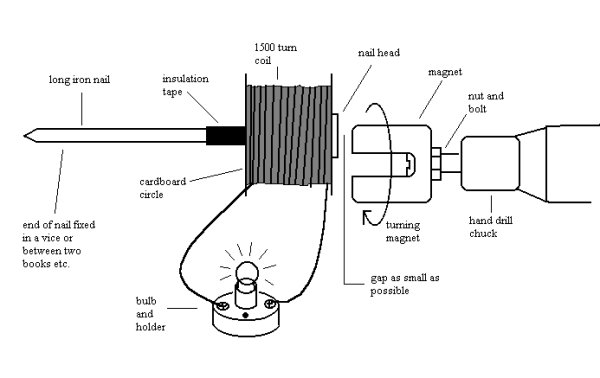
- This simple generator from the UK will help illustrate how the basics work.


- Solar Generator in a toolbox for about $200.

- Info on wind generators including output, graphs, tables you might find handy. Also, avoiding scams,

- Vertical axis wind generator. If you don't like the vanes you can make them simpler somehow.


- Pringles can generator. Eat the chips while you build it.


- Dandelion wind generator. This is a bit more complicated for beginners, but you can adapt the parts to make it simpler.

That's it for now! Maybe I'll do a post on simple solar power setups with battery banks.

Where to find cheap or free DC motors (to generate power)

  1. CD players, including computer CD players
  2. Treadmills
  3. Old VHS players. 
  4. DC computer fans. 
  5. Old computer tape drives. 
  6. Clothes dryers. 
  7. Car starter. 
  8. A DC powered fan, like this one for $15usd. 
  9. Old remote control toys, cars, boats, etc.
  10. Look for these items at Goodwill.
  11. Look at electronics surplus stores. Google "electronic surplus DC motor".
  12. Ask on Freecycle.org. There is a Freecycle site for most major US cities. Find your local Freecycle here.  
  13. If you want to buy a small DC motor go to a hobby shop.


Monday, March 21, 2016

DIY water power

If you can make something rotate, you can convert that to power using a DC motor. But using water power has some caveats. What will happen if your machinery freezes during the winter? How damaged will your equipment be? Will you have to dismantle the generator during freezing temperatures?

Here are some interesting ways to generate power with flowing water.


 - Very simple generator made with DC motor and an LED. Good to understand the concept.


- USB charger and battery bank, charged by faucet water. Uses a very tiny DC motor.

- Hydropower generators in 5 gallon buckets. Easily portable.
- A page on ram pumps and small scale hydro. This is a good starting point to browse and get familiar with different technologies out there.

- More hydropower links from the UK!