Robert Murray-Smith created his own company, FWG, with 2 partners. He is working on making a better battery. He already has a test format for powering an electric bike. Initial tests are promising. His videos are very open and he gives you recipes and instructions for making your own graphite capacitors and other energy-related items.
Sources
The FWG website.
RMS Youtube channel.
Article: http://revolution-green.com/fwg-battery-sale-robert-murray-smith/
Showing posts with label power. Show all posts
Showing posts with label power. Show all posts
Friday, November 10, 2017


Sunday, October 1, 2017
How to power things using batteries and alt power, part 2 of 2
Part 2 of 2
Power draw from the battery
If all 4 amps is being used on the Amazon inverter, how many amp hours are actually being drawn from your battery? 4 amps / 0.8 (efficiency rate), or about 5 amps per hour. Worst case scenario for an inverter that provides 4 amps: If your battery holds 20 amp hours, it will last for 20 amp hours / 5 amps per hour, or 4 hours if there is no power being added to the battery. If your battery holds 80 amp hours, it will last for 80 / 5 amps per hour, or 16 hours of continuous use with no power being added to the battery.
Examples of batteries
Below is a variety of batteries. I don't know about their quality, but let's compare the cost per amp hour of capacity. Do not use "cold cranking amps" for capacity, find the amp hours rating.
- Optima Marine battery, $200 for 55 amp hours. Cost per amp hour: $3.64usd
- 12v battery, $100 for 35 amp hours: $2.86usd
Power draw from the battery
If all 4 amps is being used on the Amazon inverter, how many amp hours are actually being drawn from your battery? 4 amps / 0.8 (efficiency rate), or about 5 amps per hour. Worst case scenario for an inverter that provides 4 amps: If your battery holds 20 amp hours, it will last for 20 amp hours / 5 amps per hour, or 4 hours if there is no power being added to the battery. If your battery holds 80 amp hours, it will last for 80 / 5 amps per hour, or 16 hours of continuous use with no power being added to the battery.
Examples of batteries
Below is a variety of batteries. I don't know about their quality, but let's compare the cost per amp hour of capacity. Do not use "cold cranking amps" for capacity, find the amp hours rating.
- Optima Marine battery, $200 for 55 amp hours. Cost per amp hour: $3.64usd
- 12v battery, $100 for 35 amp hours: $2.86usd
Saturday, September 30, 2017
How to power things using batteries and alt power, part 1 of 2
I've been looking into using solar power and batteries to power things. My first kit is used to charge a battery using a small panel, about 12" x 8", and the battery powers an LED light. The battery box also has a 5vdc USB port for charging USB things. Or simply for powering a USB device like a USB fan.
Terms
Here are some terms to get you started.
My next step was looking into using a solar and battery system to power my flat screen TV.
Alternative power usually uses an energy producing device to charge up a battery. If you use solar power (photovoltaics) you are using a solar panel to charge up a battery, and the battery stores energy for later use. You won't need lights during the daytime when the sun is out, so the battery provides power for nighttime use.
In the case of wind power or hydro power, in both cases they turn a generator to produce power, which then charges a battery for energy storage.
But how do you size the system to meet your needs? A battery provides DC power but your TV needs AC power. So you will need an inverter to change from DC to AC power. Buying an inverter based on watts it supports is not helpful. You need to look at relevant energy units, volts and amps. While watts = volts * amps, watts is just a very general way of looking at things. The inverter must provide both the volts and amps our TV needs.
My TV is rated at 12vac and 50 watts (labeled "50w" on the back of the TV). This does not tell us the amps that it draws/uses so we must calculate that. 50/120vac = 0.417 amps, or 417 milliamps (called "mA" with a big A). Amps is how much power it uses per hour. "Amp hours" is for battery capacity, and is how many hours a battery will provide 1 amp. A 1 amp hour (Ah) battery provides 1 amp for 1 hour before the voltage gets too low to be useful.
Terms
Here are some terms to get you started.
- Amps: how much current a device draws, per hour. A 1 amp device uses 1 amp per hour.
- Amp hours: the capacity of a battery. A 2 amp hour (Ah) battery provides 2 amps for 1 hour, or 1 amp for 2 hours, or 0.5 amps for 4 hours.
- Volts: volts is another measurement of a battery. Devices have a minimum voltage they need to run. A radio powered by 2 AA batteries needs about 3.0 volts to run (2 * 1.5 for each AA). An LED can work on a range of voltages. If the ideal voltage for maximum brightness of an LED is 3.3vdc, then as the battery is used up, the voltage drops, and the LED gets dimmer. The LED might go out at about 2.9vdc.
- Watts: A general unit of measure which is volts * amps used. A 12vdc device that uses 0.5 amps per hour uses 12 * 0.5, or 6 watts per hour. Electricity in the US is charged by 1000 watts per hour, or 1 kw per hour.
My next step was looking into using a solar and battery system to power my flat screen TV.
Alternative power usually uses an energy producing device to charge up a battery. If you use solar power (photovoltaics) you are using a solar panel to charge up a battery, and the battery stores energy for later use. You won't need lights during the daytime when the sun is out, so the battery provides power for nighttime use.
In the case of wind power or hydro power, in both cases they turn a generator to produce power, which then charges a battery for energy storage.
But how do you size the system to meet your needs? A battery provides DC power but your TV needs AC power. So you will need an inverter to change from DC to AC power. Buying an inverter based on watts it supports is not helpful. You need to look at relevant energy units, volts and amps. While watts = volts * amps, watts is just a very general way of looking at things. The inverter must provide both the volts and amps our TV needs.
My TV is rated at 12vac and 50 watts (labeled "50w" on the back of the TV). This does not tell us the amps that it draws/uses so we must calculate that. 50/120vac = 0.417 amps, or 417 milliamps (called "mA" with a big A). Amps is how much power it uses per hour. "Amp hours" is for battery capacity, and is how many hours a battery will provide 1 amp. A 1 amp hour (Ah) battery provides 1 amp for 1 hour before the voltage gets too low to be useful.
Saturday, August 19, 2017
Low-powered LED light in the works
From Newsatlas: A new flat-panel LED light could reduce power use tremendously. Scientists at Tohoku University in Japan have made a cheaper LED lighting device in the form of a flat panel that gets efficiency of 60 lumens per watt, which is pretty darn good for their simple device that has not been tweaked. It uses nanotubes to get this kind of efficiency.

Each carbon nanotube acts similar to a cathode ray tube when a strong electric field is applied. The electric field requires 5kv to work but the device itself uses very little power.
People have been working on other ways for LEDs to use less power. Some pulse power so fast the human eye cannot detect the LED going off and on. One project is the TritiLED which aims to light a dim LED to be used as a marker, for about 10 years. There is also the Decade Flashlight.
Update Nov 2018: My Tritiled, acquired in July 2016, has been running for 2 years straight with no problem. It's never been turned off.
Source
Newatlas.
Review of Scientific Instruments.
DDG search for articles.
Each carbon nanotube acts similar to a cathode ray tube when a strong electric field is applied. The electric field requires 5kv to work but the device itself uses very little power.
People have been working on other ways for LEDs to use less power. Some pulse power so fast the human eye cannot detect the LED going off and on. One project is the TritiLED which aims to light a dim LED to be used as a marker, for about 10 years. There is also the Decade Flashlight.
Update Nov 2018: My Tritiled, acquired in July 2016, has been running for 2 years straight with no problem. It's never been turned off.
Source
Newatlas.
Review of Scientific Instruments.
DDG search for articles.
Tuesday, August 15, 2017
Super efficient nano-LED research
This is not the same as a super efficient LED circuit where a battery could light an LED for 10 years. This is a whole new LED technology at the nanoscale.
One of the larger bottlenecks between microchips is the data connections. An optical connection, rather than a wire connection, would speed things up, but a light source small enough was not available until now. Scientists at TU Eindhoven made a nano LED that is 1000 times more efficient and can communicate at gigabits per second.
But since this article is from 2017, expect to wait another 8-10 years before we see these things in consumer devices... if it can be made at a reasonable price that is.
Source
Elektor Magazine. 3/6/2017.
One of the larger bottlenecks between microchips is the data connections. An optical connection, rather than a wire connection, would speed things up, but a light source small enough was not available until now. Scientists at TU Eindhoven made a nano LED that is 1000 times more efficient and can communicate at gigabits per second.
But since this article is from 2017, expect to wait another 8-10 years before we see these things in consumer devices... if it can be made at a reasonable price that is.
Source
Elektor Magazine. 3/6/2017.
Saturday, July 8, 2017
LED light that creates more energy than it uses?
(This is from 2012 but it's still interesting to see if this technology became a product.)
With incandescent bulbs, only 10% of the energy used is converted the light, the rest is converted to heat. Current LED diodes, (as opposed to "LED bulbs" which can contain many diodes) use only about 17% of the energy of an incandescent bulb and do not create much heat, which is good for heat-sensitive applications. For example, when I used standard (incandescent) bulbs in my outside yard light, and winters got to -20F ambient temperatures, the heat from the bulb would eventually crack and destroy the bulb itself from the sheer difference in temperature and the speed at which the bulb heated up. This was long ago and we moved to fluorescent bulbs at the time.
What if there was an LED bulb that produced more energy than it used? MIT researchers claim they have a bulb that creates energy as it uses it. It is 230% efficient, and seems to defy the laws of physics. But how to harvest that energy?
They researchers had a theory of using less voltage.
(I seriously doubt the LED produced light visible to humans but perhaps this concept can be multiplied by using 100s of LED emitters.)
Sources
Inhabitat, 3/24/2012. Retrieved 7/6/2017.
Gizmodo article. Retrieved 7/6/2017.
The journal article. Feb 27, 2012. APS.org. Retrieved: 7/6/2017.
With incandescent bulbs, only 10% of the energy used is converted the light, the rest is converted to heat. Current LED diodes, (as opposed to "LED bulbs" which can contain many diodes) use only about 17% of the energy of an incandescent bulb and do not create much heat, which is good for heat-sensitive applications. For example, when I used standard (incandescent) bulbs in my outside yard light, and winters got to -20F ambient temperatures, the heat from the bulb would eventually crack and destroy the bulb itself from the sheer difference in temperature and the speed at which the bulb heated up. This was long ago and we moved to fluorescent bulbs at the time.
What if there was an LED bulb that produced more energy than it used? MIT researchers claim they have a bulb that creates energy as it uses it. It is 230% efficient, and seems to defy the laws of physics. But how to harvest that energy?
They researchers had a theory of using less voltage.
As you may have guessed, significantly lowering the input power creates a very weak LED bulb. In their tests, the MIT researchers succeeded in generating about 70 picowatts of light from 30 picowatts of energy — an efficiency of 230 percent!Artugo Verdugo comments on the Inhabitat story:
From what I know, this LEDs are more than 100% efficient because they are using electricity+environmental heat to produce light. That means that a large portion of the power being used comes directly from the environment.At this point, neither 30 nor 70 picowatts will light any LED, but it's an interesting observation.
(I seriously doubt the LED produced light visible to humans but perhaps this concept can be multiplied by using 100s of LED emitters.)
Sources
Inhabitat, 3/24/2012. Retrieved 7/6/2017.
Gizmodo article. Retrieved 7/6/2017.
The journal article. Feb 27, 2012. APS.org. Retrieved: 7/6/2017.
Thursday, July 6, 2017
Can LED lights run for 25 years? 10 years?
Some people are working on circuits to make a dim LED light run for a year, or even 25 years. The initial attempts are to provide "marker lights". These lights are not light enough to use to walk around in the dark or read by, but they are perfect for marking tent pegs, camp sites, or trails at, for example, concerts or camp sites. They can also be used to mark latrines which are often some distance from camp sites, and be used in astronomy to possibly read text (although the lights are not very bright).
Tritium gas tubes last about 10 years, but they are expensive and not available legally in the US for hobbyists. Also there are some fakes sold on Ebay that only last a few months. In the US they can only be sold as part of a watch, gun sight or compass. Ebay does not appear to regulate plain tritium vials sold to the US.
Tritium gas tubes last about 10 years, but they are expensive and not available legally in the US for hobbyists. Also there are some fakes sold on Ebay that only last a few months. In the US they can only be sold as part of a watch, gun sight or compass. Ebay does not appear to regulate plain tritium vials sold to the US.
Tuesday, January 10, 2017
Batteroo post updated
The Batteroo post has been updated as people test the device. Read up here.
Basically I thought it was possible to miniaturize a Joule Thief but this device doesn't even do that. It's a total scam.
Basically I thought it was possible to miniaturize a Joule Thief but this device doesn't even do that. It's a total scam.
Sunday, December 11, 2016
Batteroo: voltage booster for AA and AA cells
The Battero is a voltage booster that is a sleeve that goes round your AA or AAA battery cells, very common cells used in the US market. That means it can boost the voltage to your items get more use out of the battery. Normally, a 1.5vdc AA battery is considered dead when it reaches 1.2v. The Batteroo boosts the voltage higher so the device thinks the battery has more juice than it does.
The Batteroo got a lot of criticism because it make outrageous claims like extending battery life 800%. That is not true, but it does extend battery life. The concept of a voltage booster is also called Joule Thief. The concept is simple, but the key for the Batteroo was miniturizing the components to fit as a sleeve around the AA battery.
More Batteroos scheduled to be sold in Jan 2017. Stay tuned. I'll be testing one of these.
I haven't seen any Joule Thief flashlights out there. Most flashlights concentrate on guzzling power to get a high brightness to blind a UFO. But if you want a power-sipping LED light that works on dead batteries, go here to Etsy.
EDIT: Further Batteroo testing by several people revealed the Batteroo does nothing to improve battery life. So it appears it's not even a tiny Joule Thief.
I assumed there was some potential here if they really miniaturized a Joule Thief, and improved battery life about 20-40%, but test results indicate that it's a total scam.
The Batteroo got a lot of criticism because it make outrageous claims like extending battery life 800%. That is not true, but it does extend battery life. The concept of a voltage booster is also called Joule Thief. The concept is simple, but the key for the Batteroo was miniturizing the components to fit as a sleeve around the AA battery.
More Batteroos scheduled to be sold in Jan 2017. Stay tuned. I'll be testing one of these.
I haven't seen any Joule Thief flashlights out there. Most flashlights concentrate on guzzling power to get a high brightness to blind a UFO. But if you want a power-sipping LED light that works on dead batteries, go here to Etsy.
EDIT: Further Batteroo testing by several people revealed the Batteroo does nothing to improve battery life. So it appears it's not even a tiny Joule Thief.
- EEVBlog video here, with toy train test.
- EEVBlog post about the Batteroo testing. You will need a free account to comment.
- Wikipedia entry on Batteroo.
I assumed there was some potential here if they really miniaturized a Joule Thief, and improved battery life about 20-40%, but test results indicate that it's a total scam.
San Jose State University's Kiumars Parvin claimed, "We tested the Batteriser sleeve in our lab and we confirmed that the Batteriser taps into 80 percent of energy that is usually thrown away."Now if you don't know how marketers talk, you will totally misunderstand the above statement. The statement does not say "it uses up all of the other 80% of the battery power". It says "it taps into (uses some of) the wasted 80% of battery power."
In the test by UL (safety organization), a Garmin Golf GPS using Batteriser was shown to have a lifespan of 10 hours and 12 minutes, in contrast to the 1 hour and 43 minutes of operating time without a Batteriser.[8] However, later the test was independently duplicated by TechnologyCatalyst to demonstrate that Garmin runs OK for over 17 hours on ordinary AA batteries, and the report by UL was based on the sloppy test design.Test design matters, quite a bit, apparently. A better test might be how many milliamps the device uses with and without the Batteroo. Power meters on different devices are designed differently and can be misleading.
Tuesday, October 18, 2016
Charge your phone with a banana
Yes, this should work, given that you use 2 different types of metals, one for the positive lead one for the negative lead. Any acidic solution will work, whether it's from an orange, lemon, apple, or, I guess, even a banana.

Source
Device Byte.

Source
Device Byte.
Sunday, October 16, 2016
Generate 1 kw of electricity with a 1C degree temperature gradient
Fujifilm has developed a thermoelectric material that will generate 1kw of electricity with a temperature difference of only 1 degree C. Peltier devices, available on Amazon and Ebay, can also generate electricity but generally require a thermal gradient of 100 degrees F or more to get 4-5 volts DC, and not that many milliamps.

I want one!
More thermoelectric gadgets on the market at Pinterest.
Info on a Tin-Selenide TE material.

I want one!
More thermoelectric gadgets on the market at Pinterest.
Info on a Tin-Selenide TE material.
Sunday, March 27, 2016
DIY wind power
This post is about various types of DIY wind power, from small systems for the very beginner, to more advanced systems. I'm trying to find some very simple wind systems for beginners, that means, fewer parts is better. But sometimes a person needs a larger generator for serious use. Wind power is not reliable in all weather so people usually end up using wind power to charge up a battery bank for use later, like at night.
Anything that produces rotational movement can be used to turn a DC motor and generate power. Some people use wind power, but others use water power. Water power is more complicated because you have to have a way to keep parts from getting wet and rusting. Rust can damage or seize parts.
NOTES:
- Pringles wind tunnel. You can reverse this and use the DC fan to generate power. Very creative!

- This wind generator uses wind coming out of an air conditioner, so that energy doesn't go to waste.

- A small wind generator suitable for kids to make age 10-18. It uses PVC and a DC motor. You can use almost any DC motor. If you apply DC electricity (batteries) to a DC motor, the axle will spin. If you spin the axle, you get power out of the leads.

- This page contains several wind generators. The bigger ones get more expensive.
- Another wind generator (MotherEarth news) which uses 4 basic parts. It looks like 2 parts are an auto cooling fan and an alternator. With fewer parts, this one would be good for beginners.

- This simple generator from the UK will help illustrate how the basics work.

- Solar Generator in a toolbox for about $200.

- Info on wind generators including output, graphs, tables you might find handy. Also, avoiding scams,
- Vertical axis wind generator. If you don't like the vanes you can make them simpler somehow.

- Pringles can generator. Eat the chips while you build it.
- Dandelion wind generator. This is a bit more complicated for beginners, but you can adapt the parts to make it simpler.

That's it for now! Maybe I'll do a post on simple solar power setups with battery banks.
Anything that produces rotational movement can be used to turn a DC motor and generate power. Some people use wind power, but others use water power. Water power is more complicated because you have to have a way to keep parts from getting wet and rusting. Rust can damage or seize parts.
NOTES:
- You can use the fan blades and fan blade hub from a small, cheap house fan, and hook it up to a DC motor, and stand.
- Pringles wind tunnel. You can reverse this and use the DC fan to generate power. Very creative!

- This wind generator uses wind coming out of an air conditioner, so that energy doesn't go to waste.

- A small wind generator suitable for kids to make age 10-18. It uses PVC and a DC motor. You can use almost any DC motor. If you apply DC electricity (batteries) to a DC motor, the axle will spin. If you spin the axle, you get power out of the leads.

- This page contains several wind generators. The bigger ones get more expensive.
- Another wind generator (MotherEarth news) which uses 4 basic parts. It looks like 2 parts are an auto cooling fan and an alternator. With fewer parts, this one would be good for beginners.

- This simple generator from the UK will help illustrate how the basics work.
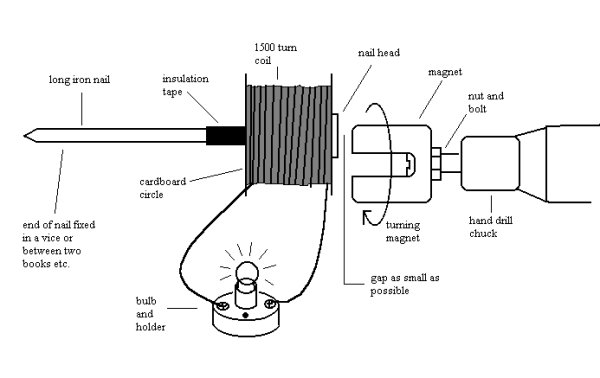
- Solar Generator in a toolbox for about $200.

- Info on wind generators including output, graphs, tables you might find handy. Also, avoiding scams,
- Vertical axis wind generator. If you don't like the vanes you can make them simpler somehow.

- Pringles can generator. Eat the chips while you build it.
- Dandelion wind generator. This is a bit more complicated for beginners, but you can adapt the parts to make it simpler.

That's it for now! Maybe I'll do a post on simple solar power setups with battery banks.
Where to find cheap or free DC motors (to generate power)
- CD players, including computer CD players
- Treadmills
- Old VHS players.
- DC computer fans.
- Old computer tape drives.
- Clothes dryers.
- Car starter.
- A DC powered fan, like this one for $15usd.
- Old remote control toys, cars, boats, etc.
- Look for these items at Goodwill.
- Look at electronics surplus stores. Google "electronic surplus DC motor".
- Ask on Freecycle.org. There is a Freecycle site for most major US cities. Find your local Freecycle here.
- If you want to buy a small DC motor go to a hobby shop.
Monday, March 21, 2016
DIY water power
If you can make something rotate, you can convert that to power using a DC motor. But using water power has some caveats. What will happen if your machinery freezes during the winter? How damaged will your equipment be? Will you have to dismantle the generator during freezing temperatures?
Here are some interesting ways to generate power with flowing water.
- Very simple generator made with DC motor and an LED. Good to understand the concept.

- USB charger and battery bank, charged by faucet water. Uses a very tiny DC motor.

- Hydropower generators in 5 gallon buckets. Easily portable.
 - A page on ram pumps and small scale hydro. This is a good starting point to browse and get familiar with different technologies out there.
- More hydropower links from the UK!
Here are some interesting ways to generate power with flowing water.
- Very simple generator made with DC motor and an LED. Good to understand the concept.

- USB charger and battery bank, charged by faucet water. Uses a very tiny DC motor.

- Hydropower generators in 5 gallon buckets. Easily portable.

- More hydropower links from the UK!
Subscribe to:
Posts (Atom)