Tesla (maker of electric cars) wants to help Puerto Rico rebuild their power grid. The hurricane destroyed most of the power grid, and in some areas, 100% of people were out of power for 2 or more weeks.
Tesla wants to help build a new solar power grid by storing power in giant battery banks, and distributing that power over power lines. This would be a networked design so there would be solar collectors and battery banks in several different cities. The PR power company was on the verge of bankruptcy when the hurricane hit so the power infrastructure was already poor, damaged, and need of repair at best.
Tesla has already sent hundreds of Powerwalls to help people, but those need electricity to recharge.
Sources
Youtube video.
Showing posts with label solar power. Show all posts
Showing posts with label solar power. Show all posts
Monday, November 13, 2017


Sunday, October 1, 2017
How to power things using batteries and alt power, part 2 of 2
Part 2 of 2
Power draw from the battery
If all 4 amps is being used on the Amazon inverter, how many amp hours are actually being drawn from your battery? 4 amps / 0.8 (efficiency rate), or about 5 amps per hour. Worst case scenario for an inverter that provides 4 amps: If your battery holds 20 amp hours, it will last for 20 amp hours / 5 amps per hour, or 4 hours if there is no power being added to the battery. If your battery holds 80 amp hours, it will last for 80 / 5 amps per hour, or 16 hours of continuous use with no power being added to the battery.
Examples of batteries
Below is a variety of batteries. I don't know about their quality, but let's compare the cost per amp hour of capacity. Do not use "cold cranking amps" for capacity, find the amp hours rating.
- Optima Marine battery, $200 for 55 amp hours. Cost per amp hour: $3.64usd
- 12v battery, $100 for 35 amp hours: $2.86usd
Power draw from the battery
If all 4 amps is being used on the Amazon inverter, how many amp hours are actually being drawn from your battery? 4 amps / 0.8 (efficiency rate), or about 5 amps per hour. Worst case scenario for an inverter that provides 4 amps: If your battery holds 20 amp hours, it will last for 20 amp hours / 5 amps per hour, or 4 hours if there is no power being added to the battery. If your battery holds 80 amp hours, it will last for 80 / 5 amps per hour, or 16 hours of continuous use with no power being added to the battery.
Examples of batteries
Below is a variety of batteries. I don't know about their quality, but let's compare the cost per amp hour of capacity. Do not use "cold cranking amps" for capacity, find the amp hours rating.
- Optima Marine battery, $200 for 55 amp hours. Cost per amp hour: $3.64usd
- 12v battery, $100 for 35 amp hours: $2.86usd
Saturday, September 30, 2017
How to power things using batteries and alt power, part 1 of 2
I've been looking into using solar power and batteries to power things. My first kit is used to charge a battery using a small panel, about 12" x 8", and the battery powers an LED light. The battery box also has a 5vdc USB port for charging USB things. Or simply for powering a USB device like a USB fan.
Terms
Here are some terms to get you started.
My next step was looking into using a solar and battery system to power my flat screen TV.
Alternative power usually uses an energy producing device to charge up a battery. If you use solar power (photovoltaics) you are using a solar panel to charge up a battery, and the battery stores energy for later use. You won't need lights during the daytime when the sun is out, so the battery provides power for nighttime use.
In the case of wind power or hydro power, in both cases they turn a generator to produce power, which then charges a battery for energy storage.
But how do you size the system to meet your needs? A battery provides DC power but your TV needs AC power. So you will need an inverter to change from DC to AC power. Buying an inverter based on watts it supports is not helpful. You need to look at relevant energy units, volts and amps. While watts = volts * amps, watts is just a very general way of looking at things. The inverter must provide both the volts and amps our TV needs.
My TV is rated at 12vac and 50 watts (labeled "50w" on the back of the TV). This does not tell us the amps that it draws/uses so we must calculate that. 50/120vac = 0.417 amps, or 417 milliamps (called "mA" with a big A). Amps is how much power it uses per hour. "Amp hours" is for battery capacity, and is how many hours a battery will provide 1 amp. A 1 amp hour (Ah) battery provides 1 amp for 1 hour before the voltage gets too low to be useful.
Terms
Here are some terms to get you started.
- Amps: how much current a device draws, per hour. A 1 amp device uses 1 amp per hour.
- Amp hours: the capacity of a battery. A 2 amp hour (Ah) battery provides 2 amps for 1 hour, or 1 amp for 2 hours, or 0.5 amps for 4 hours.
- Volts: volts is another measurement of a battery. Devices have a minimum voltage they need to run. A radio powered by 2 AA batteries needs about 3.0 volts to run (2 * 1.5 for each AA). An LED can work on a range of voltages. If the ideal voltage for maximum brightness of an LED is 3.3vdc, then as the battery is used up, the voltage drops, and the LED gets dimmer. The LED might go out at about 2.9vdc.
- Watts: A general unit of measure which is volts * amps used. A 12vdc device that uses 0.5 amps per hour uses 12 * 0.5, or 6 watts per hour. Electricity in the US is charged by 1000 watts per hour, or 1 kw per hour.
My next step was looking into using a solar and battery system to power my flat screen TV.
Alternative power usually uses an energy producing device to charge up a battery. If you use solar power (photovoltaics) you are using a solar panel to charge up a battery, and the battery stores energy for later use. You won't need lights during the daytime when the sun is out, so the battery provides power for nighttime use.
In the case of wind power or hydro power, in both cases they turn a generator to produce power, which then charges a battery for energy storage.
But how do you size the system to meet your needs? A battery provides DC power but your TV needs AC power. So you will need an inverter to change from DC to AC power. Buying an inverter based on watts it supports is not helpful. You need to look at relevant energy units, volts and amps. While watts = volts * amps, watts is just a very general way of looking at things. The inverter must provide both the volts and amps our TV needs.
My TV is rated at 12vac and 50 watts (labeled "50w" on the back of the TV). This does not tell us the amps that it draws/uses so we must calculate that. 50/120vac = 0.417 amps, or 417 milliamps (called "mA" with a big A). Amps is how much power it uses per hour. "Amp hours" is for battery capacity, and is how many hours a battery will provide 1 amp. A 1 amp hour (Ah) battery provides 1 amp for 1 hour before the voltage gets too low to be useful.
Thursday, September 7, 2017
Europe renewable energy consumption is up to 76% in some places
Renewable energy consumption as percent of total energy consumption is 76% in some places. Iceland uses 76% of energy from renewables but that is probably mostly geothermal. But other numbers range from 11 to 50%.

Source
Alternet.

Source
Alternet.
Tuesday, August 22, 2017
Printable solar panels
There has been news about printable solar cells going back to 2008-2012, and it's worth looking into. There should have been consumer products on the market by now (2017) since these cells are cheaper to print (though the article I saw didn't say if they are cheaper per square inch or cheaper per watt of power generated).But I haven't been able to confirm that the flexible solar cells are indeed printed.
So here is a smattering of articles to get you going.
2008: This article mentions Konarka company making printed solar cells. http://inhabitat.com/printable-solar-cells-demonstrated/
2011: News from MIT. http://news.mit.edu/2011/printable-solar-cells-0711
2017: An article from Science Daily, Feb 2017. https://www.sciencedaily.com/releases/2017/02/170216142800.htm
June 2017. University of Newcastle in Australia print solar cells. These cells are translucent and let some sunlight in while at the same time generate power. These are great for putting in south-facing windows in the northern hemisphere. http://planetark.org/news/display/1281
If you have a link to print your own solar cells at home, please leave a comment with the link to share with others. Thanks!
EDIT: While not exactly printed, Power Film Solar has flexible solar panels.
Links
Printable Solar Cells. Book on printing solar cells.
So here is a smattering of articles to get you going.
2008: This article mentions Konarka company making printed solar cells. http://inhabitat.com/printable-solar-cells-demonstrated/
2011: News from MIT. http://news.mit.edu/2011/printable-solar-cells-0711
2017: An article from Science Daily, Feb 2017. https://www.sciencedaily.com/releases/2017/02/170216142800.htm
A new innovation could make printing solar cells as easy and inexpensive as printing a newspaper. Researchers have cleared a critical manufacturing hurdle in the development of a relatively new class of solar devices called perovskite solar cells. This alternative solar technology could lead to low-cost, printable solar panels capable of turning nearly any surface into a power generator.Wikipedia: Inkjet solar cells. Retrieved Aug 21, 2017.
June 2017. University of Newcastle in Australia print solar cells. These cells are translucent and let some sunlight in while at the same time generate power. These are great for putting in south-facing windows in the northern hemisphere. http://planetark.org/news/display/1281
If you have a link to print your own solar cells at home, please leave a comment with the link to share with others. Thanks!
EDIT: While not exactly printed, Power Film Solar has flexible solar panels.
Links
Printable Solar Cells. Book on printing solar cells.
Thursday, August 3, 2017
S. Korean bike highway shades path with solar roof
The runs between Daejon and Sejong, and is covered for 20 miles with a roof of solar panels. Those panels not only
generate lots of electricity but also shield cyclists from the sun.
Video:
Source
Fast Company.
Video:
Source
Fast Company.
Monday, July 31, 2017
First family solar car hits market for $119k euros.
The Dutch startup Lightyear has just released it's first solar car Lightyear One for 119,000 euros ($139,945 usd at the time of this blog post writing.) It has a 500km (310 miles) driving range. At this price, most Dutch must be super rich.
No comment on how it recharges in the winter in the northern European sun, or lack thereof. You might be better off with a $100usd trickle charger in your front window hooked to the cigarette lighter.
Source
PV Magazine.
No comment on how it recharges in the winter in the northern European sun, or lack thereof. You might be better off with a $100usd trickle charger in your front window hooked to the cigarette lighter.
Source
PV Magazine.
Tuesday, May 16, 2017
Beginner solar starter kit for $70!
Here it is: One solar panel, charge controller with 4000mah lithium battery, 2 LED light bulbs, for $70usd. I have this one and it works great.
Here's one for $61usd: two lightbulbs, 8000mah hour battery, charge controller, solar panels.
These can be good for sheds or workshops too!
Notes about solar power.
- The solar panel has brackets to mount the panel on the roof at the correct angle, and has long wires from the solar panel so you can link to the battery indoors.
- Also has 1 USB charging port, with USB cable with many adapters.
- Charging box (contains battery) also has on/off switch which turns off all lights to make sure no energy is used during vacation. Each light bulb has a tiny red LED to show you there is power going to it.
- I will splice in a voltmeter to monitor the voltage myself later.
Here's one for $61usd: two lightbulbs, 8000mah hour battery, charge controller, solar panels.
These can be good for sheds or workshops too!
Notes about solar power.
- The systems above are too small to run a TV but work fine for LED lights, which are typically low powered. Since some of the systems have a USB port, those will run any USB device like a small light, fan, or charge power banks, etc.
- Charging of the battery can take a long time in overcast or dark weather. Batteries charge best in full sun where the suns rays hit the solar panel at 90 degrees.
- Solar panels should be placed in south-facing windows or on the roof facing south.
- Latitudes of the earth go from zero (equator) to 90 degrees (north or south pole). The best angle for the solar panel is (if you live in the Northern hemisphere): the angle formed between the ground and the panel should equal your latitude. I.e. at 30 degrees, closer to the equator, the angle would be 30 degrees from the ground, or close to horizontal. For latitude 85, the panel should be 85 degrees from the ground, or nearly vertical. At 43 degrees latitude put the panel at 43 degrees to the ground. This will help your panel get the most sunlight as the sun moves throughout the day.
Saturday, May 13, 2017
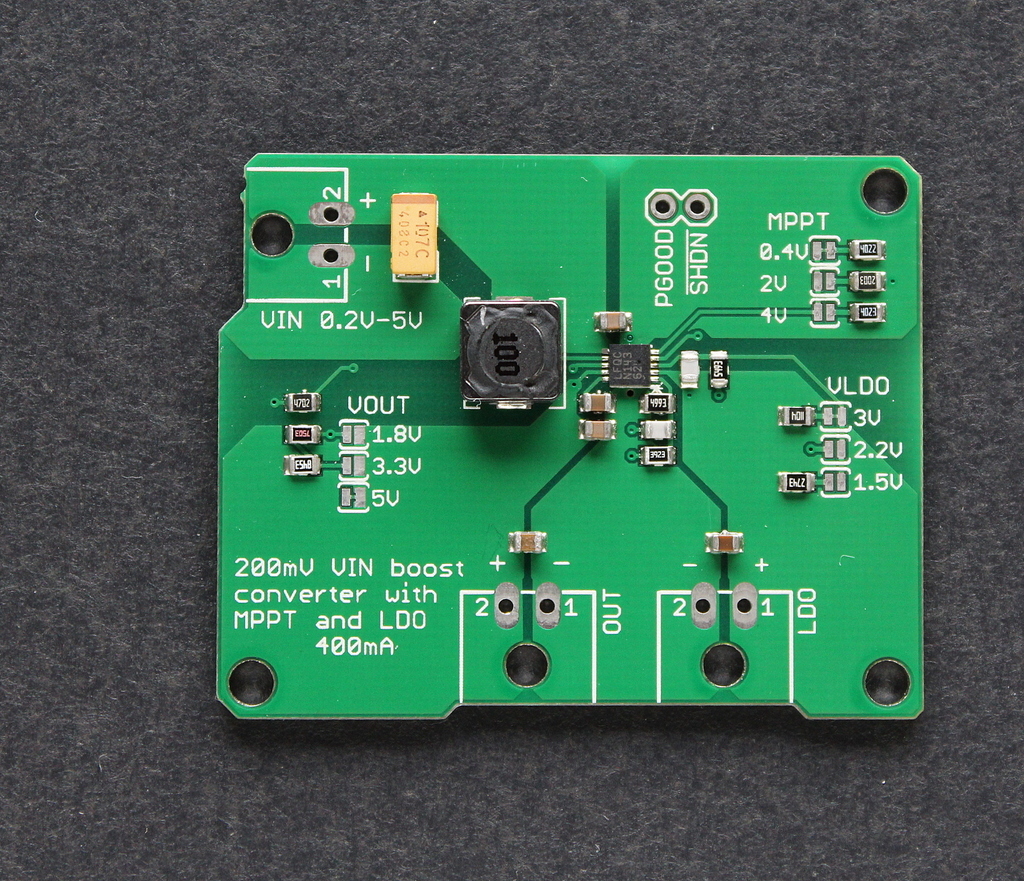
Voltage booster goes from 225mv to 5.0vdc!
This [voltage booster](http://www.ebay.com/itm/LTC3105-Energy-Harvester-demo-module/332136264440?_trksid=p2047675.c100005.m1851&_trkparms=aid%3D222007%26algo%3DSIC.MBE%26ao%3D2%26asc%3D40130%26meid%3De7f86a5b8374439ab3c85d2657cfcb85%26pid%3D100005%26rk%3D3%26rkt%3D6%26sd%3D332071662285) on Ebay takes input as low as 225mv and boosts it to 3.3v or 5vdc.
This can be really useful for boosting power from solar panels on a cloudy day, thermoelectric generation, using the last bit of juice from batteries, and more! WARNING: do not over discharge lithium batteries! They can be permanently damaged. A booster like this would be for like AA alkaline batteries.
The seller, ceech123, has several other similar boards, one even for 2.7v supercaps.

This can be really useful for boosting power from solar panels on a cloudy day, thermoelectric generation, using the last bit of juice from batteries, and more! WARNING: do not over discharge lithium batteries! They can be permanently damaged. A booster like this would be for like AA alkaline batteries.
The seller, ceech123, has several other similar boards, one even for 2.7v supercaps.
Monday, June 13, 2016
Solar in rental units
"85% savings with energy storage" said the headline.
Another quote:
Using insulating technologies to save energy could help. Living underground is one idea but you just can't push dirt against a building and make it work. First the building has to be engineered enough to withstand the pressure of the dirt from all the sides. Second, even if it's legal according to zoning laws (which prevent many many people from using wind power), most people do not have the cash to do such a thing. An underground house, in most cases, must be built from scratch.
The other issue working against people installing alternative energy solutions is spelled out here:
Source
Clean Technica.
Another quote:
“The addition of storage technologies has the potential to nearly double stand-alone solar electricity bill savings at about a third of the cost of solar. For example, the addition of a $112,100 battery storage system to a $385,000 solar installation increased savings from $15,000 per year to $27,900, an 85 percent increase in savings for only a 29 percent increase in cost.”So, to pay for the $385k solar installation, with a savings of $27,900 per year, means it would take 385,000/27900, or 13 years to break even. $385k is capital that most mom and pop, and even many corporate rental companies do not have. We really need more cost-effective ways for the little individual family to go with solar or storage technologies, and even that won't benefit some people. Only in some areas is the cost of energy going up much too fast.
Using insulating technologies to save energy could help. Living underground is one idea but you just can't push dirt against a building and make it work. First the building has to be engineered enough to withstand the pressure of the dirt from all the sides. Second, even if it's legal according to zoning laws (which prevent many many people from using wind power), most people do not have the cash to do such a thing. An underground house, in most cases, must be built from scratch.
The other issue working against people installing alternative energy solutions is spelled out here:
“Median rents in California increased by over 20 percent from 2000 to 2012, while the median income dropped by 8 percent, significantly driving up the percentage of income that California households must spend on rent.”Incomes keep going up, or stay the same and lost to increases costs. The inflation rate only tracks the AVERAGE cost of goods in the US or at the state level. It has nothing to do with people not getting a raise in 10 years, increase out-of-pocket medical expenses, higher taxes from Obamacare and other sources, and other factors.
Source
Clean Technica.
Friday, June 3, 2016
US cost of solar KW/hour pushing 5-5.8 cents.
But this is mostly in the southwest US. What about us freezing up in Michigan?
See Graph.

Source
CleanTechnica.
See Graph.

Source
CleanTechnica.
Tuesday, May 17, 2016
Solar power costs even lower today
NV Energy, has agreed to purchase electricity from the 100 MW Playa Solar 2 power plant at a low price of $0.0387/kWh! My rate in Michigan is $.09 per kWh.
According to this graphic, wind energy is cheaper. This shows price per MW hour. But prices for grid electricity is per KW hour. KWh = 1000 * MWh.

Source
Clean Technica. July 10, 2015.
Wednesday, March 30, 2016
Simple DIY LED lights
This post is about making simple LED light circuits. LEDs are Light Emitting Diodes, and as such, they use DC power (batteries) to create light. If you plug an LED light into an AC wall plug, you will need to convert the AC electricity to DC, which gets more complicated. LEDs use less power, so they last longer on batteries, and many systems use solar power to charge the batteries, so they are a lower power option which use less energy, and therefore create less pollution.
Do remember to recycle batteries whenever you can.You can recycle batteries at Batteries Plus, or do a Google search for a place in your town.
There are a few light movements to provide solar-charged LED lights to kids in Africa so they can actually do homework at night with these lights. These lights are often inexpensive, and effective.
NOTE:

- How to choose resistors for an LED light. Nice clear picture.
- Another page with a simple drawing of a basic LED circuit, designed for beginners.

- The LED throwy is one of the simplest LED projects. It is just an LED taped to a coin cell battery, taped to an optional magnet. It has no switch.

- The Instructables LED page, a collection of LED projects. One can use those UPS batteries for all kinds of things, especially because they are rechargable.
- Glowing mushroom log from Yukio Takano.

- LED Lights for beginners. From Instructables. This is a good one which shows you how to calculate resistor values. Resistor values vary depending on how much power is in your power source. A 9v battery (9vdc) requires a different resistor than 2 AA batteries (3vdc).
- 9v LED light "lamp" made from credit card plastic parts.
- LEDAfrica.org shows some interesting lighting and battery concepts.
- The Blocklite sits on a 9v battery. It has high and low modes.
 - Here's a variation on the 9v blocklite, the Pak-lite.

Do remember to recycle batteries whenever you can.You can recycle batteries at Batteries Plus, or do a Google search for a place in your town.
There are a few light movements to provide solar-charged LED lights to kids in Africa so they can actually do homework at night with these lights. These lights are often inexpensive, and effective.
NOTE:
- LEDs have a negative and positive leg.
Do not mix them up or your LED will go "poof"!Actually you can mix up the legs, and it just won't work. But if you apply too much voltage, then the LED will go "poof". This page has an image showing you that the LED has a flat side, which is the negative side. - If you add a switch, you can add it anywhere in the circuit to cut power.
- If you get a brighter LED, 1 watt or larger, it will generate a lot of heat and you might need a heatsink.
LED flashlight runs on dead batteries
Here on Etsy.DIY LED lights, beginner
- 9v LED light. This one is easy because it tells you exactly which resistor to use. And 9v batteries are sold at the US Dollar Tree.
- How to choose resistors for an LED light. Nice clear picture.
- Another page with a simple drawing of a basic LED circuit, designed for beginners.
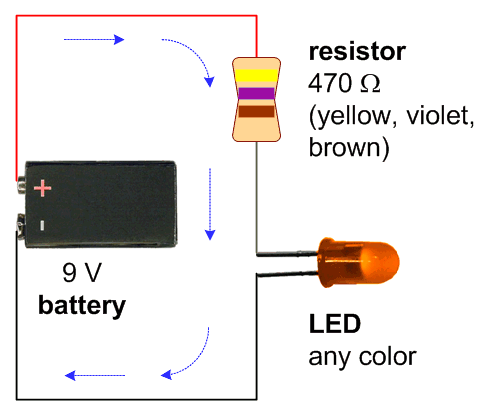
- The LED throwy is one of the simplest LED projects. It is just an LED taped to a coin cell battery, taped to an optional magnet. It has no switch.
More fun with LEDs
- The top 30 LED projects includes: LED bench, solar powered tree decoration, LED ping pong balls, LED chess set, LED swing, and more.- The Instructables LED page, a collection of LED projects. One can use those UPS batteries for all kinds of things, especially because they are rechargable.
- Glowing mushroom log from Yukio Takano.

- LED Lights for beginners. From Instructables. This is a good one which shows you how to calculate resistor values. Resistor values vary depending on how much power is in your power source. A 9v battery (9vdc) requires a different resistor than 2 AA batteries (3vdc).
- 9v LED light "lamp" made from credit card plastic parts.
Simple commercial lights and concepts
Since Africa is leading this movement, sometimes I call these "African lights".- LEDAfrica.org shows some interesting lighting and battery concepts.
- The Blocklite sits on a 9v battery. It has high and low modes.


Sunday, March 13, 2016
Which are the most efficient solar cells?
Soitec and Fraunhofer Institute has produced PV cells with a 46% efficiency. These are called "concentrator quadruple-junction" cells. They are very expensive and are used in space applications where power is critical.
Sharp produces a type called triple-junction solar cells with an efficiency of 44.4%.
A Spanish solar research institute (IES) produces a two-junction cell with 32.6% efficiency.
SunPower creates modules with a 21.5% efficiency.
Q-Cells hold the record for thin-film solar with a 17.4% efficiency.
First Solar creates thin-film cells with 17% efficiency, but they are the Cadmium Telluride (CdTe) type of thin-film cells.
There are even more categories and subcategories but this page (in Links below) has a great graph showing efficiencies over time for different categories and subcategories of PV cells.

Links
- Solarlove.org.
- Wikipedia has a good page on many types of solar cell technologies. It also has a table of the price of PV cells in US Dollars per watt. The US is the most expensive right now. US prices of electricity run from 9 to 12 cents per kilowatthour. Keep in mind that in some countries solar power is heavily paid for by the gov't, i.e. taxpayers. This brings down the cost of solar power for the consumer.
- Wikipedia also explains solar cell efficiency.
- NREL is the US National Renewable Energy Laboratory. It has a section on solar power, and is the source of the graph above. This page has an an updated graph direct from NREL. This links to the actual image. They also have solar maps which show you which areas get the most sunlight. More solar maps here.

Saturday, March 12, 2016
CdTe PV cell now at 22% efficiency
First Solar has created a photovoltaic cell (the common solar cells we all know) with an efficiency rate of 22%. As newer solar cells are produced in greater numbers they will become cheaper, and might even compete with electric utilities. Not all states have a plan to allow your solar cells to sell your excess energy back to the utility.
There are other PV cells which are more efficient, but this is the most efficient CdTe cell.
There are other PV cells which are more efficient, but this is the most efficient CdTe cell.
Wednesday, March 9, 2016
Small invertor packs a punch
Invertors are used to convert DC electricity, created by solar panels or batteries, into AC electricity, used by many appliances. A Belgian company, Red Electrical Devils, managed to pack 142.9 watts per square inch into a 14 cubic inch box. The company ended up winning $1 million in Google's Little Box Challenge.
Smaller invertors means more portable power, which helps spread the non-polluting solar power.
Greentechmedia seems like a good source for green power news. The site is well-organized into subcategories.
Smaller invertors means more portable power, which helps spread the non-polluting solar power.
Greentechmedia seems like a good source for green power news. The site is well-organized into subcategories.
Thursday, February 25, 2016
World Trade Org ruled against India's solar program, and less pollution
It seems like the WTO is ruling for more pollution when it ruled against Indian's solar program. List of WTO related docs here.
It seems the US filed a complaint with the UN, from WTO document WT/DS456/R:
India has named the solar program as a core component of its contribution to the Paris agreement to tackle climate change. But today, the WTO released its ruling against India's National Solar Mission, deciding that India's efforts to boost local production of solar cells violated WTO rules. Though India argued that the program helps the country to meet its climate commitments under the United Nations Framework Convention on Climate Change (UNFCCC), the WTO rejected that argument.It seems common sense should rule when we're talking about addressing climate change, but good, even great, ideas seem to get killed by technicalities.
It seems the US filed a complaint with the UN, from WTO document WT/DS456/R:
1.1. On 6 February 2013 and 10 February 2014, the United States requested consultations with India pursuant to Articles 1 and 4 of the Understanding on Rules and Procedures Governing the Settlement of Disputes (DSU), Article XXII of the General Agreement on Tariffs and Trade 1994 (GATT 1994), and Article 8 of the Agreement on Trade-Related Investment Measures (TRIMs Agreement) with respect to the measures and claims set out below. 1
You can read WT/DS456/R and decide for yourself.
Subscribe to:
Posts (Atom)