 |
| Carpenter bee, notice flat abdomen. |
IBPES has
released a report (http://www.ipbes.net/article/press-release-pollinators-vital-our-food-supply-under-threat) that shows how pollinators are being killed off by over 57 agricultural chemicals. 75% of the world's food relies, at least in part, on pollinators including moths, wasps, butterflies, bats, beetles, and birds.
US$235 billion and US$577 billion worth of annual global food production relies on pollinators.
The bee Colony Collapse Disorder is believed to be from a deadly cocktail of pesticides that eventually overwhelms the bees' systems and kills them, often in a very short time. Neonicotinoids are especially harmful to invertebrates like bees.
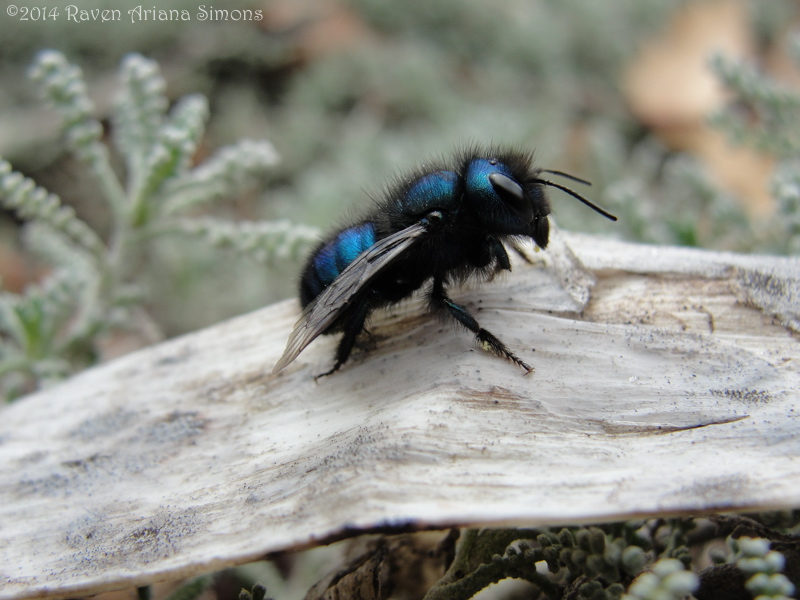 |
| Blue orchard bee |
|
But neonics are not the only culprit. The theory is various chemicals act in concert, making the bees susceptible to illness and Varroa mites.
Scientists cannot agree on a single factor which causes CCD. Scientists thinking one dimensionally is major problem in many areas of science. The world is not that simple anymore where one factor explains everything. The world is a complex mix of factors, each factor affecting an individual differently. This is no longer the 1800s where the scientists just have to identify one bacteria which causes an illness, then develop one medicine to kill that bacterium.
Other factors adding to the likelihood of CCD are: Israeli Acute Paralysis Virus, a fungus called Nosema, a common anti-fungal used to treat Nosema, fumagillin. From Wikipedia:
In 2013, researchers collected pollen from hives and fed it to healthy
bees. The pollen had an average of nine different pesticides and
fungicides. Further, the researchers discovered that bees that ate
pollen with fungicides were three times more likely to be infected by
parasites. Their study shows that fungicides, thought harmless to bees,
may actually play a significant role in CCD.
This is an example of sub-lethal effects. The fungicides do not kill the bees, they likely weaken the bees, which leads to an increased rate of sickness among the colony.
Some people are also concerned that selective breeding of bees for rent (to pollinate crops) has lead to less diversity, and less flexibility in the bee population. It's sort of like monocropping: it's possible you can get one pathogen that can affect the majority of bees.
How can I encourage bees?
- Plant flowers that attract bees.
- Do not use pesticides in your garden. Look for organic solutions instead.
- Make bee houses.
Links to DIY bee houses
- Bee house from NWF.They say place on the (sunny) south side of the house. I hope larva are not
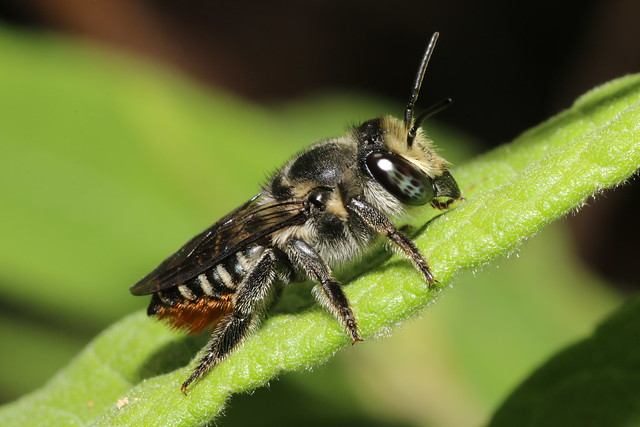 |
| Leaf cutter bee. Notice funky elongated eyes, fuzzy abdomen. |
inside the house in the peak of summer temperatures!
- Living Green and Frugally bee house. More ideas for a mason bee house.
- Mason bee house in an old log, just drill various sized holes.
- Leaf cutter bee house. Leaf cutter bees are lively, curious, and cut leaves to line their individual nests. Leaf cutters are not dangerous but they will zip around your head once or twice to check you out. Do not mistake curiosity for aggressiveness.
Notes about bee houses
- Do not use cedar. It is repellent and toxic to many insect species.
- Use a hardwood like oak, maple, hickory. Do not use pine. Pine can repel some species of insects and it doesn't last long in the open weather.
- Check to make sure the holes are for the size of bee you want to attract.
- Use plastics at your own risk. They can still leach poisonous phthalates.
- Don't use MDF or chip board, it will dissolve in the rain.
- Angle the holes downward a bit so water will drain out.
- Site the bee house away from people and traffic. Give them some privacy. High traffic areas may not attract as many bees.
Links
Wikipedia Colony Collapse Disorder.

